
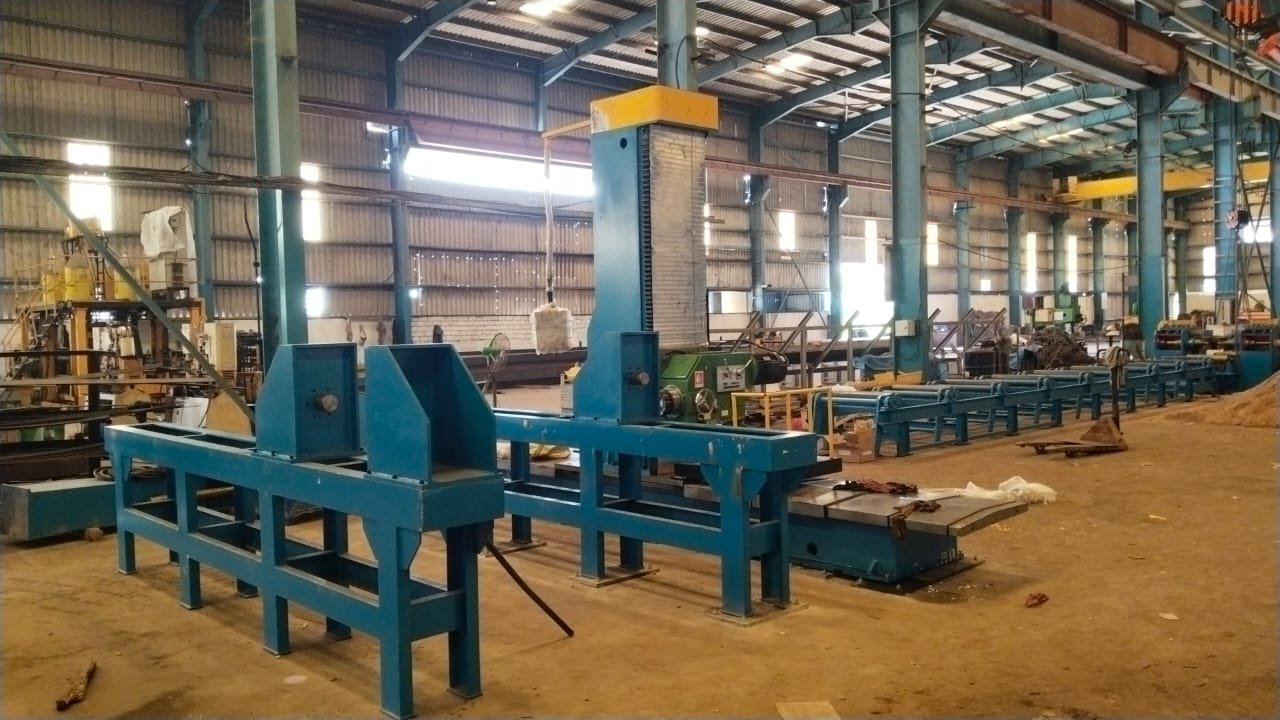
A CNC H-Beam End Milling Machine faces and bevels the cut ends of welded or rolled H-beams so they meet site-erection tolerances — flat, square, and at the correct bevel angle for the joint they'll be welded into on site. It's typically the last precision step before a beam leaves the fabrication shop, run after welding and straightening. ACM supplies this machine to fabricators in Uttar Pradesh and across North India working in PEB, structural steel, and heavy engineering, where end-face accuracy directly affects how cleanly beams fit and weld together on the erection site.
What is a CNC H-Beam End Milling Machine? A CNC H-Beam End Milling Machine mills the flat end face of a welded or rolled H-beam or box-beam to a precise, square finish, and can bevel that face at an angle for site-weld joint preparation. It's a CNC-controlled step that replaces manual grinding or hand-cutting of beam ends.
How do I choose the right CNC H-Beam End Milling Machine? Match the machine's table size and beam capacity to your largest beam cross-section, confirm the bevel angle range covers the joint types you fabricate (0–45° is standard), and check whether you need automatic or semi-automatic operation based on your daily beam-end throughput.
CNC H-Beam End Milling Machine Supplier in Uttar Pradesh
A welded H-beam can be structurally sound and still fail at the erection site if its ends aren't flat, square, and cut to the right bevel angle. That's the specific problem a CNC H-Beam End Milling Machine solves — it takes a beam that's already been welded and straightened, and mills both end faces to a finish accurate enough for site welding or bolted connection.
Here's why this step gets skipped by shops that shouldn't skip it: on smaller jobs, it's tempting to hand-grind or torch-cut beam ends to "close enough." The problem shows up later, on site, when a beam that's off-square by even a few millimeters doesn't seat properly against its connecting member — and re-cutting steel on an erection site is far more expensive than getting it right in the shop.
ACM supplies CNC H-Beam End Milling Machines to fabricators across Uttar Pradesh and North India who need this level of end-face accuracy built into their process rather than left to manual finishing. The machine handles both H-beams and box-beams, and adjusts for the angled bevel cuts that site-welded structural joints commonly require.
What End Milling Actually Fixes (and Why It Matters)
Three things go wrong with hand-finished beam ends, and a CNC end milling machine addresses all three directly:
- Squareness. A hand-ground or torch-cut end face is rarely perfectly perpendicular to the beam's length. Off-square ends mean the beam doesn't sit flush against its connecting member, which either forces the erection crew to compensate on site or leaves a gap that weakens the joint.
- Flatness. Even a squared cut can be uneven across the face — high spots and low spots that a manual grinder struggles to catch without a lot of extra time. A milled face is flat across its whole surface in one controlled pass.
- Bevel accuracy. Many site-welded structural joints need the beam end cut at a specific angle (commonly adjustable 0–45°), not a flat square face. Getting that angle right by hand is slow and inconsistent between beams; a CNC-controlled milling head holds the same angle across every beam in a batch.
Specifications of CNC H-Beam End Milling Machine
| Parameter | Value |
|---|---|
| Material handled | Mild steel H-beams and box-beams |
| Application | H-beam end face milling, plate facing |
| Capacity | 1500 x 3000 mm |
| Table size | 2000 x 3500 mm |
| Automation grade | Semi-Automatic |
| Voltage | 415 V |
| Frequency | 50 Hz |
| Bevel angle range | 0–45° (adjustable) |
Applications
- PEB fabrication shops. Beam ends milled to spec here reduce the fit-up corrections erection crews would otherwise need on site, which is where PEB project delays commonly originate.
- Structural steel fabricators. Shops producing beams for bridges, industrial platforms, or multi-storey steel frames rely on accurate end faces for bolted or welded splice connections between beam sections.
- Heavy engineering and custom fabrication. Shops handling varied, non-standard beam sizes use end milling to hold consistent finish quality across a mixed order book, rather than relying on operator skill for each job.
Milling vs. Manual Grinding: Which Should You Use?
| Factor | CNC End Milling | Manual Grinding/Torch Cutting |
|---|---|---|
| Squareness consistency | High — held by machine, not operator | Varies by operator skill and fatigue |
| Bevel angle accuracy | Repeatable across a batch | Difficult to hold consistently |
| Speed per beam (batch runs) | Faster once set up | Slower for volume, faster for a single one-off |
| Best suited for | Regular production runs, tight tolerances | Occasional, low-volume, non-critical ends |
| Rework risk on site | Lower | Higher |
Why Source It From ACM
ACM supplies this machine to fabricators across Uttar Pradesh and India, positioned to help match the table size and bevel-angle range to the beam sizes you're actually running rather than a one-size listing.
If price or delivery timeline is a concern relative to alternatives: talk to ACM directly about your beam-size range and expected volume before comparing quotes, since machine sizing affects price more than any other single factor.