
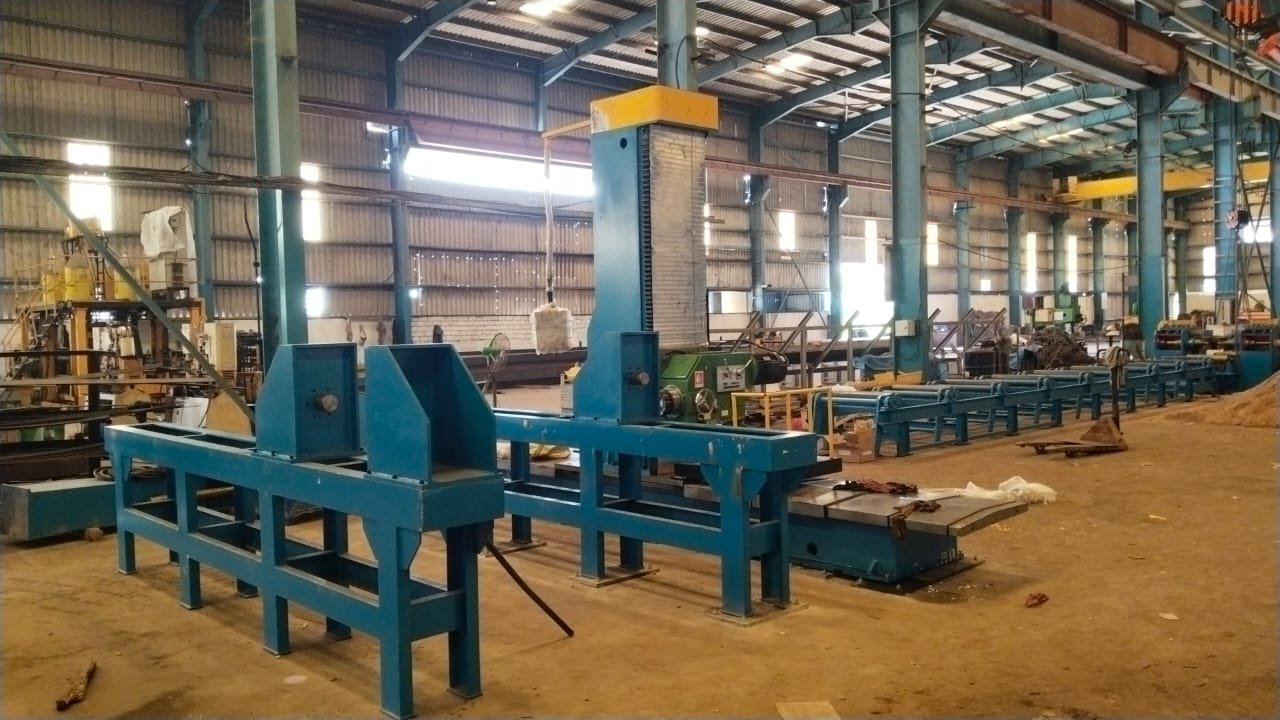
A CNC H-Beam End Milling Machine faces and bevels the cut ends of welded or rolled H-beams so they meet site-erection tolerances — flat, square, and at the correct bevel angle for the joint they'll be welded into on site. It's typically the last precision step before a beam leaves the fabrication shop, run after welding and straightening. ACM supplies this machine to fabricators in Jammu & Kashmir and across North India working in PEB, structural steel, and heavy engineering, where end-face accuracy directly affects how cleanly beams fit and weld together on the erection site.
What is a CNC H-Beam End Milling Machine? A CNC H-Beam End Milling Machine mills the flat end face of a welded or rolled H-beam or box-beam to a precise, square finish, and can bevel that face at an angle for site-weld joint preparation. It's a CNC-controlled step that replaces manual grinding or hand-cutting of beam ends.
How do I choose the right CNC H-Beam End Milling Machine? Match the machine's table size and beam capacity to your largest beam cross-section, confirm the bevel angle range covers the joint types you fabricate (0–45° is standard), and check whether you need automatic or semi-automatic operation based on your daily beam-end throughput.
CNC H-Beam End Milling Machine Supplier in Jammu & Kashmir
A welded H-beam can be structurally sound and still fail at the erection site if its ends aren't flat, square, and cut to the right bevel angle. That's the specific problem a CNC H-Beam End Milling Machine solves — it takes a beam that's already been welded and straightened, and mills both end faces to a finish accurate enough for site welding or bolted connection.
Here's why this step gets skipped by shops that shouldn't skip it: on smaller jobs, it's tempting to hand-grind or torch-cut beam ends to "close enough." The problem shows up later, on site, when a beam that's off-square by even a few millimeters doesn't seat properly against its connecting member — and re-cutting steel on an erection site is far more expensive than getting it right in the shop.
ACM supplies CNC H-Beam End Milling Machines to fabricators across Jammu & Kashmir and North India who need this level of end-face accuracy built into their process rather than left to manual finishing. The machine handles both H-beams and box-beams, and adjusts for the angled bevel cuts that site-welded structural joints commonly require.
What End Milling Actually Fixes (and Why It Matters)
Three things go wrong with hand-finished beam ends, and a CNC end milling machine addresses all three directly:
- Squareness. A hand-ground or torch-cut end face is rarely perfectly perpendicular to the beam's length. Off-square ends mean the beam doesn't sit flush against its connecting member, which either forces the erection crew to compensate on site or leaves a gap that weakens the joint.
- Flatness. Even a squared cut can be uneven across the face — high spots and low spots that a manual grinder struggles to catch without a lot of extra time. A milled face is flat across its whole surface in one controlled pass.
- Bevel accuracy. Many site-welded structural joints need the beam end cut at a specific angle (commonly adjustable 0–45°), not a flat square face. Getting that angle right by hand is slow and inconsistent between beams; a CNC-controlled milling head holds the same angle across every beam in a batch.
Specifications of CNC H-Beam End Milling Machine
| Parameter | Value |
|---|---|
| Material handled | Mild steel H-beams and box-beams |
| Application | H-beam end face milling, plate facing |
| Capacity | 1500 x 3000 mm |
| Table size | 2000 x 3500 mm |
| Automation grade | Semi-Automatic |
| Voltage | 415 V |
| Frequency | 50 Hz |
| Bevel angle range | 0–45° (adjustable) |
Applications
- PEB fabrication shops. Beam ends milled to spec here reduce the fit-up corrections erection crews would otherwise need on site, which is where PEB project delays commonly originate.
- Structural steel fabricators. Shops producing beams for bridges, industrial platforms, or multi-storey steel frames rely on accurate end faces for bolted or welded splice connections between beam sections.
- Heavy engineering and custom fabrication. Shops handling varied, non-standard beam sizes use end milling to hold consistent finish quality across a mixed order book, rather than relying on operator skill for each job.
Milling vs. Manual Grinding: Which Should You Use?
| Factor | CNC End Milling | Manual Grinding/Torch Cutting |
|---|---|---|
| Squareness consistency | High — held by machine, not operator | Varies by operator skill and fatigue |
| Bevel angle accuracy | Repeatable across a batch | Difficult to hold consistently |
| Speed per beam (batch runs) | Faster once set up | Slower for volume, faster for a single one-off |
| Best suited for | Regular production runs, tight tolerances | Occasional, low-volume, non-critical ends |
| Rework risk on site | Lower | Higher |
Why Source It From ACM
ACM supplies this machine to fabricators across Jammu & Kashmir and India, positioned to help match the table size and bevel-angle range to the beam sizes you're actually running rather than a one-size listing.
If price or delivery timeline is a concern relative to alternatives: talk to ACM directly about your beam-size range and expected volume before comparing quotes, since machine sizing affects price more than any other single factor.