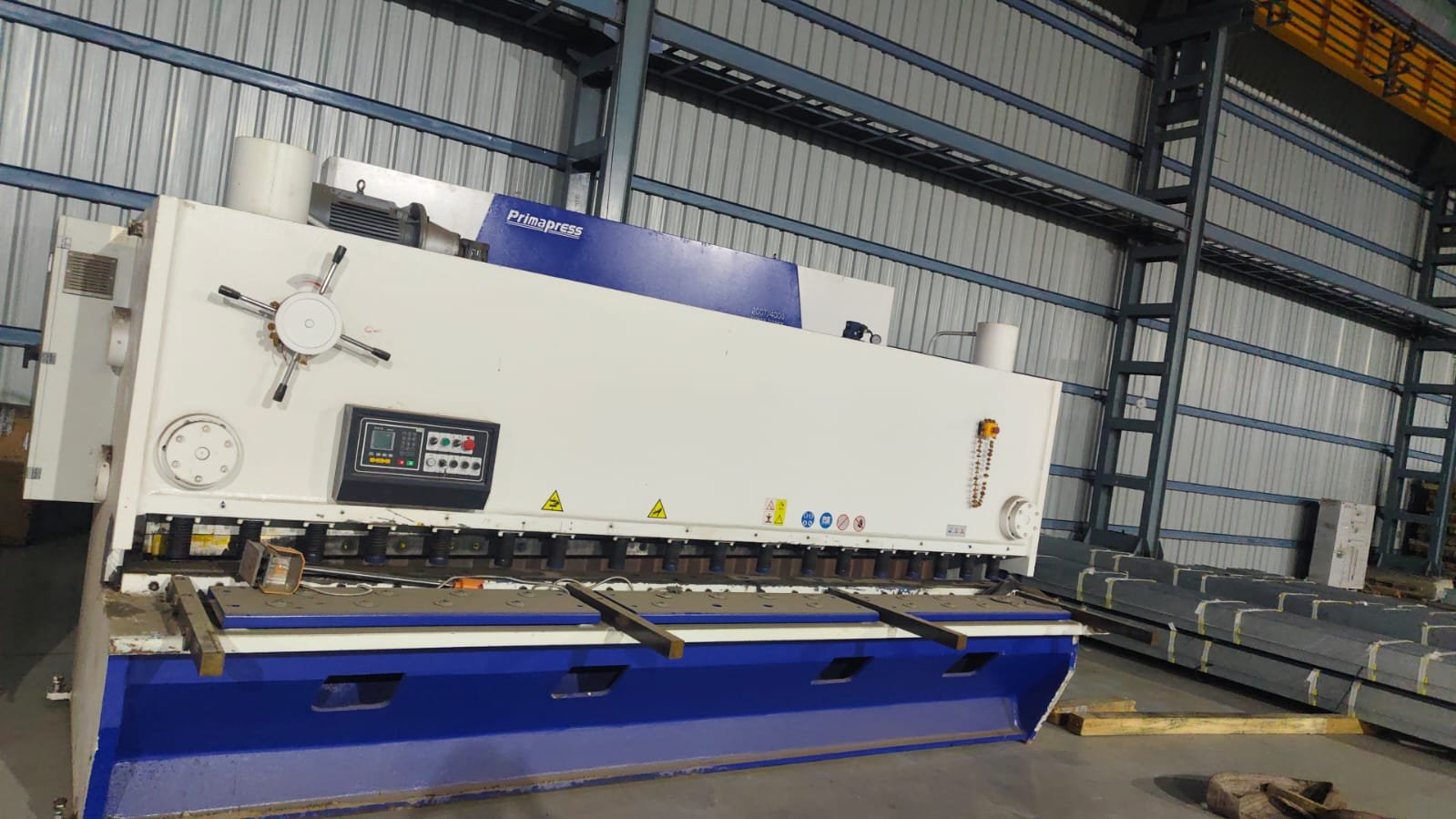
A Plate Shearing Machine cuts flat metal sheet or plate into straight, precise sizes using an upper and lower blade that apply concentrated shearing force through the material — no heat, no melting, no burr-heavy edge the way plasma or gas cutting can leave. It's typically the first sizing step in a fabrication line, cutting stock plate down to the dimensions needed before bending, drilling, or welding. ACM supplies hydraulic plate shearing machines to fabricators in Amritsar and across North India who need fast, clean, straight cuts on sheet and plate steel without the heat-affected edge that thermal cutting methods leave behind.
What is a Plate Shearing Machine? A Plate Shearing Machine cuts flat metal sheet or plate to size using an upper blade that presses down against a fixed lower blade, shearing the material along a straight line without heat. It's a mechanical cutting method, distinct from plasma, laser, or oxy-fuel cutting, which all cut using heat.
How do I choose the right Plate Shearing Machine? Match the machine's maximum thickness capacity to your thickest regular material — not your average job — and confirm the cutting length covers your widest plate. Then decide between guillotine (adjustable rake angle) and swing-beam (fixed angle, generally lower cost) depending on whether you need that flexibility.
Plate Shearing Machine Supplier in Amritsar
Cutting plate steel to size sounds simple until the edge quality actually matters — a heat-cut edge from plasma or gas cutting comes with a hardened, sometimes distorted zone right along the cut line, which can complicate downstream welding or bending. A Plate Shearing Machine avoids that problem entirely by cutting mechanically: one blade presses down, the other holds firm, and the material separates along a clean, straight line with no heat involved.
[Add: a real example — a specific job or client type where clean, heat-free edges have mattered most]
That makes it the natural first step in most fabrication sequences — plate comes in at stock size, gets sheared down to the dimensions the job actually needs, and only then moves to bending, drilling, or welding. ACM supplies hydraulic plate shearing machines to fabricators in Amritsar and across North India handling structural steel, PEB components, and general sheet metal work where straight, clean cuts matter before the material goes anywhere else.
How Shearing Actually Cuts Metal
Two blades do the work — one fixed on the machine bed, one mounted on a moving beam above it. When the beam comes down, the moving blade doesn't cut straight through like a saw; it applies concentrated pressure that exceeds the material's shear strength, causing it to fracture cleanly along the line between the two blades. No heat, no melting, no slag.
The gap between the blades (blade clearance) and the angle at which the top blade meets the material (rake angle) both affect cut quality and the force required. A larger rake angle needs less force but leaves a slightly more sloped cut edge; a smaller rake angle gives a cleaner, more square edge but demands more cutting force for the same thickness. Guillotine-type shears let this angle be adjusted; swing-beam shears run a fixed angle.
Guillotine vs. Swing-Beam Shears
| Factor | Guillotine Shear | Swing-Beam Shear |
|---|---|---|
| Rake angle | Adjustable (typically 0.5°–3°) | Fixed |
| Cut edge quality control | More precise — can balance quality vs. capacity | Less adjustable |
| Typical cost | Higher | Generally lower |
| Best suited for | Shops needing edge-quality flexibility across varied thickness | Shops with consistent material thickness and simpler needs |
If your work involves a wide range of plate thicknesses and edge quality matters for what comes next (precision welding, tight-fit assembly), a guillotine shear's adjustable rake angle earns its higher cost. If you're mostly cutting a consistent thickness for less quality-sensitive downstream work, a swing-beam shear is often the more cost-effective choice.
Specifications (Typical Range for Hydraulic Guillotine Shears)
| Parameter | Typical Range |
|---|---|
| Max material thickness | 6 mm – 20 mm (mild steel) |
| Max cutting length | 2,500 mm – 6,000 mm |
| Rake angle | 0.5° – 3° (adjustable, guillotine type) |
| Power source | Hydraulic |
| Backgauge | CNC or manually adjustable, for repeat-size cutting |
| Blade material | Alloy tool steel, hardened |
Plate Shearing Machine vs. Plate Bending Machine
Worth clarifying since both are plate-processing machines and buyers sometimes search for one meaning the other:
| Factor | Plate Shearing Machine | Plate Bending Machine |
|---|---|---|
| What it does | Cuts plate to size (straight-line separation) | Bends or rolls plate into a curved or angled shape |
| Where it sits in the process | First — sizes stock before further processing | Later — shapes plate that's already cut to size |
| Tooling | Upper and lower blades | Rollers or punch-and-die |
If you need to cut plate down to size, this is the right machine. If you need to curve or bend plate that's already sized, ACM's Plate Bending Machine is the one you want instead.
Why Source It From ACM
ACM supplies hydraulic plate shearing machines to fabricators across Amritsar and North India, and can help match thickness capacity and cutting length to the plate sizes you're actually processing rather than a generic catalog spec.
If price or delivery timeline relative to alternatives is a concern: share your typical plate thickness and cutting length needs with ACM before comparing quotes, since machine sizing determines fit more than the headline capacity number alone.