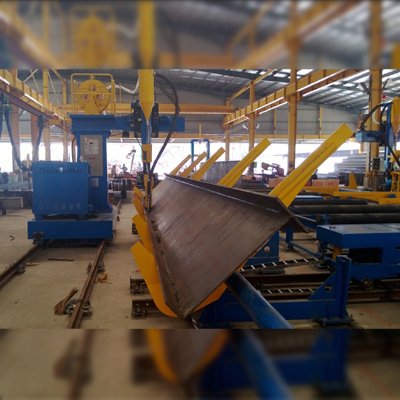
An H-Beam Welding Machine converts individually cut flange and web plates into a single, structurally sound H-shaped beam, welding both flange-to-web joints in a continuous, seam-tracked pass. It's the core station in any H-beam fabrication line, sitting between the assembly/tacking stage and the straightening stage. ACM manufactures and supplies these machines from Ahmedabad, Haryana, for fabricators serving the PEB, steel structure, and heavy engineering sectors across India. Machines are built to handle varying web heights and flange widths, with welding parameters that hold consistent penetration across the full beam length — not just at the ends where operators tend to check.
H-Beam Welding Machine Manufacturer in Ahmedabad
A steel beam only holds up under load if its web and flange plates are welded true along the entire length — not just tacked in a few spots and hoped for. That's the job an H-Beam Welding Machine does. It takes flange plates and a web plate that have already been aligned and tack-welded into an H cross-section, and runs a continuous, tracked weld down both joints where the web meets each flange.
Most fabrication shops in and around Ahmedabad feed these machines from a plate-cutting stage (plasma or oxy-fuel) and pass the welded beam onward to a straightening unit before dispatch. ACM builds the welding station to sit in that sequence, whether a client is buying it standalone or as part of a fuller line. The reason the welding stage matters more than it looks: a beam that's been hand-welded or welded on an under-powered machine tends to show inconsistent penetration toward the middle of long runs, where an operator's attention naturally drifts. A dedicated machine with seam-tracking doesn't have that problem — it holds the same weld parameters at meter 1 and meter 12.
Buyers researching this machine are usually one of two types: a fabricator setting up a new PEB or steel-structure line and speccing every station from scratch, or an existing shop replacing a bottleneck machine that can't keep pace with cutting and assembly upstream. Either way, the welding station is where beam quality is actually decided.
Why Choose ACM's H-Beam Welding Machine
- Seam-tracking arc guidance. The welding head follows the actual joint line rather than a pre-programmed straight path, so beams that come out of the tacking stage with minor misalignment still get a correctly seated weld.
- Submerged arc process for deep penetration. SAW keeps the arc buried under flux, which means fewer spatter losses and more consistent fusion depth than open-arc processes — particularly relevant on thicker flange-to-web joints.
- Handles a working range, not a single spec. The machine is built to weld across a practical range of web heights and flange widths rather than one fixed size, so a shop isn't locked into a single beam profile.
- Stable welding speed under load. Speed doesn't degrade as the beam gets longer or the plate gets thicker within the machine's rated range — output stays predictable across a shift, not just in test conditions.
- Fits into an existing line or runs standalone. Positioned to accept beams from a separate tacking/assembly station and hand off to a separate straightening station, so a fabricator upgrading one stage at a time doesn't need to replace the whole line.
Specifications
| Parameter | Typical Range |
|---|---|
| Web height | 200 mm – 2,000 mm+ (model-dependent) |
| Flange width | 200 mm – 1,000 mm+ (model-dependent) |
| Welding process | Submerged Arc Welding (single or twin-wire) |
| Beam length capacity | Up to 12,000–18,000 mm (model-dependent) |
| Power supply | 380–420V, 50 Hz |
| Automation grade | Automatic / semi-automatic |
| Cooling | Air-cooled |
Benefits
- Fewer rejected beams. Consistent penetration along the full weld length means fewer beams flagged at quality check for weak spots mid-run.
- Predictable daily output. Once the machine is set for a beam profile, output per shift becomes a number you can plan around instead of estimate.
- Lower rework cost. Automated tracking cuts down the manual grinding and re-welding that hand-finished joints often need.
- Easier scheduling across order sizes. A working range wide enough to cover most of your order book means fewer machine changeovers between jobs.
- Reduced dependence on welder skill variance. Weld quality stops being tied to which operator is on shift that day.
- Smoother handoff to straightening. A cleanly and evenly welded beam distorts more predictably, which makes the straightening stage faster and more consistent.
- Lower long-run material waste. Fewer under-penetrated joints means fewer beams scrapped or sent for costly rework.
- Room to grow order sizes. A machine sized with margin above current typical orders means larger contracts don't require an immediate re-purchase.
Comparison: Standalone Welding Station vs. Integrated Assembly-Welding-Straightening Line
| Factor | Standalone Welding Machine | Integrated Line (Assembly + Welding + Straightening) |
|---|---|---|
| Upfront cost | Lower | Higher |
| Fits existing setup | Yes, if tacking/straightening already exist | Requires full-line commitment |
| Floor space | Smaller footprint | Larger footprint |
| Material handling between stages | Manual or semi-automated transfer needed | Continuous, integrated transfer |
| Best suited for | Shops upgrading one stage at a time | New setups building a full fabrication line |
Why Buy From Us
ACM manufactures and supplies from Ahmedabad — a region with an established base of CNC and welding-equipment fabricators, which keeps parts and service reachable for clients across India.
If price, delivery timeline, or customization limits are a concern: ACM builds machines to the buyer's stated web-height and flange-width range rather than offering only fixed standard sizes, and delivery timelines can be discussed against the buyer's project schedule before order confirmation.