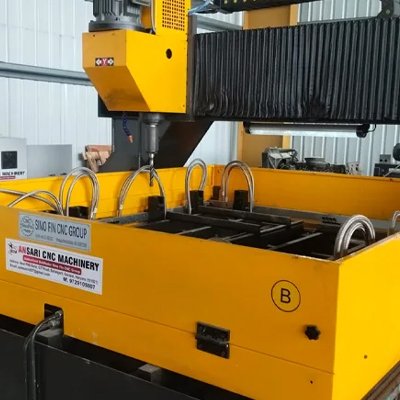
ACM's CNC Plate Drilling Machine is built for structural steel fabricators, PEB manufacturers, and heavy engineering units that need consistent, repeatable hole patterns on mild steel and stainless steel plates without manual marking or re-positioning. Bed size / Max plate dimensions and Suitable number of drilling heads let the machine handle production runs that would otherwise tie up a radial drill for hours. As a Kanpur-based manufacturer and supplier, ACM works directly with fabrication shops across Kanpur — from single-machine enquiries to full production-line integration.
CNC Plate Drilling Machine in Kanpur — ACM
A CNC Plate Drilling Machine takes a hole pattern straight from your drawing file and drills it into the plate — no manual center-punching, no marking table, no eyeballing a tape measure against a template. For a fabrication shop running the same base-plate or gusset-plate pattern fifty times a week, that difference alone changes how a job gets scheduled.
ACM manufactures and supplies these machines out of Kanpur, a region with one of the highest concentrations of structural steel fabricators and PEB manufacturers in North India. That matters more than it sounds like it should: a machine built without contact with real shop-floor plate-handling problems — heavy plates that need to be craned on and off, coolant that has to survive continuous multi-hole cycles, operators who need a control panel they can actually learn in a day — tends to show its gaps within the first few months of use.
What makes CNC drilling worth the capital cost, for most buyers, isn't raw speed on a single hole — it's that hole #40 on a plate is exactly as accurate as hole #1, at 2am on a night shift, without a second person checking measurements.
Why Choose ACM's CNC Plate Drilling Machine — Features
-
Multiple Simultaneous Drilling Heads— As required number independent drilling heads work the plate at the same time rather than indexing one spindle across the full pattern, which is where most of the cycle-time advantage over a single-spindle radial drill comes from on multi-hole patterns.
-
Servo-Driven Axis Positioning— X and Y axis movement runs on ball-screw drive with servo motor control, so the machine repositions to the next hole coordinate automatically from the loaded program — the plate doesn't get re-clamped or re-marked between holes.
-
High-Rigidity Structural Frame— The machine bed and gantry are built to resist deflection under continuous drilling load on thick plate stock — flex in the frame is what causes hole-diameter drift on longer production runs, and it's usually the first thing that separates a machine built for occasional use from one built for a full shift.
-
CNC Control Panel with DXF/CAD Import— Hole patterns load directly from a DXF or CAD drawing rather than requiring the operator to manually key in every coordinate — this is what removes marking-table time from the process entirely, not just drilling time.
-
Automatic Chip and Coolant Management— Continuous drilling on structural plate generates a lot of swarf; a chip conveyor and through-tool coolant delivery keep the work zone clear and extend drill bit life, which matters more on long runs than it looks like it should on paper.
Benefits of CNC Plate Drilling Machine
- Consistent hole accuracy across the entire production run. Once the program is loaded, hole #1 and hole #100 land at the same coordinates — no cumulative drift from manual re-measuring.
- Frees skilled labour from repetitive marking work. Your fabricator stops spending hours center-punching plates and can be reassigned to welding, fit-up, or quality checks instead.
- Shorter turnaround on repeat orders. Once a hole pattern is programmed and saved, re-running it for a repeat order doesn't require re-marking from scratch.
- Fewer rejected plates from mis-drilled holes. Manual marking error is one of the more common causes of scrapped structural plate; automated positioning removes that variable.
- Better quoting confidence on multi-hole jobs. Drilling time becomes predictable once you know the machine's cycle time per hole, which makes estimating large orders more reliable.
- Lower long-term tooling cost from through-tool coolant. Proper coolant delivery extends drill bit life compared to manual drilling setups where coolant application is inconsistent.
- Easier documentation for quality audits. A saved CNC program is a repeatable, checkable record of what was drilled and where — useful when a client or auditor asks how a hole pattern was produced.
- Scales with order volume without scaling headcount. One operator can run multiple plates through a programmed cycle instead of needing a marking hand and a driller both dedicated to the job.
Manufacturing Process of Our Product
- Frame Fabrication and Stress Relieving. The base structure is welded and stress-relieved to prevent warping under drilling load over the machine's working life.
- Precision Machining of Guideways. Rail and ball-screw mounting surfaces are machined to the tolerance required for the linear motion components to run without play.
- Component Assembly. Spindle heads, servo motors, drive systems, and the control cabinet are fitted and aligned.
- Wiring and Control Integration. The CNC controller, PLC, and drive electronics are wired and the control software is configured for the machine's axis configuration.
- Calibration and Test Drilling. The machine drills test patterns on sample plate stock to verify positional accuracy across the full working area before dispatch.
CNC vs. Manual Plate Drilling
| Factor | Manual/Radial Drilling | CNC Plate Drilling |
|---|---|---|
| Hole positioning | Manual marking + measuring, cumulative error risk | Programmed from DXF/CAD, consistent across full run |
| Speed on repeat patterns | Re-marked every time | Program saved and re-run instantly |
| Operator skill dependency | High — accuracy tied to individual operator | Lower — accuracy comes from the program, not the operator |
| Best suited for | One-off or low-volume plates | Repetitive, multi-hole, or high-volume production |
| Labour requirement | Marking + drilling as separate steps | Largely automated after setup |
| Documentation/audit trail | Difficult to reconstruct after the fact | Saved CNC program is a repeatable record |
Applications / Use Cases of CNC Plate Drilling Machine
- Structural Steel Fabrication. Base plates, gusset plates, and connection plates for building structures need hole patterns matched exactly to bolt layouts specified in structural drawings — a mismatch here means a rejected plate on-site.
- Pre-Engineered Building (PEB) Manufacturing. PEB plants run high volumes of near-identical plate patterns across a project; CNC drilling is where that repetition actually pays off in cycle time.
- Heavy Engineering & Machine Base Fabrication. Equipment mounting plates and machine bases often carry thicker stock and tighter positional tolerance than standard structural work.
- Railway & Infrastructure Fabrication. Bracket plates and mounting components for railway and infrastructure projects typically need to match standardized drawings across large batch quantities.
- Bridge & Tower Component Manufacturing. Gusset and connection plates for bridge and transmission tower structures often carry certification requirements around hole tolerance that manual drilling struggles to guarantee consistently.
Why Buy From ACM (Ansari CNC Machinery)
ACM is based in Kanpur and works directly with fabrication shops in the region rather than through a layer of distributors, which means enquiries, spec discussions, and service requests go straight to the people who build the machine.
Maintenance & Usage Tips
- Check and top up way lubrication regularly — dry guideways are one of the fastest routes to positional drift.
- Clear chip buildup daily, not just when it becomes visibly excessive — accumulated swarf affects coolant flow and can mark the plate surface.
- Inspect drill bits for wear before starting a large batch run — a dulling bit changes hole diameter gradually, which is easy to miss mid-run.
- Verify coolant concentration and flow at the start of each shift, particularly before drilling stainless steel, which is more heat-sensitive than mild steel.
- Re-check zero-point calibration periodically, especially after the machine has been idle for an extended period.
- Keep the control cabinet clean and ventilated — dust ingress into electronics is a common cause of avoidable downtime in a fabrication shop environment.